Setting out from Poole to resume the South West Coast Path
The Salt PathSetting out from Poole to resume the South West Coast Path is a reversal at once practical and symbolic: Ray and Moth arrive at the route’s official endpoint, then set off in the opposite direction to finish the stretch they had left incomplete. Still without a home, and facing Moth’s worsening illness, they take up walking again because its daily movement offers purpose and a measure of control. The path gives them somewhere to go, but it cannot make the future beyond it certain.
From homelessness to the first steps
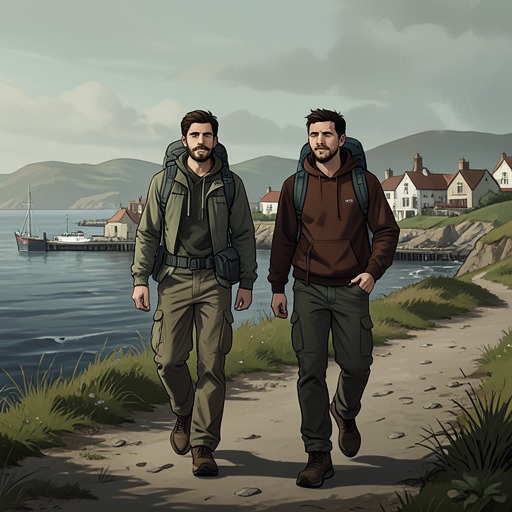
The journey’s first beginning had come in Taunton, where Ray and Moth stood with their rucksacks beside them and understood that they were truly homeless. Travel had once meant moving away with the assurance that a door remained available for return; now there was no door. They had fifty pounds left, and the path was meant to give them a reason to keep moving and a way to shape what came next. Their immediate destination was Minehead, reached by bus, and the walk began as a choice made under conditions that left little else to do.
At the start monument in Minehead, they delayed among the crowds, adjusting their packs and taking photographs before taking the first step. Excitement and fear sat beside their homelessness and the knowledge of Moth’s illness. At half past three on a Thursday afternoon, they began a walk of 630 miles. The physical reality arrived quickly: on the steep zigzag through the woods above Minehead, the route proved far more punishing than the guidebook’s mild description suggested. They stopped on a bench to catch their breath and reread the directions, discovering that the path’s demands could not be inferred from the map’s language.
What walking made possible
The route became knowledge acquired through the body. On a later climb, Ray’s legs, hips, and shoulders hurt; the exposed rock reflected heat onto their faces. Yet the height and wind brought a sensation of release, while Moth leaned away from the sea as they followed the cliff path. Pain and exhilaration were not opposites so much as alternating parts of the same effort: each rise, turn, and view changed what the landscape felt like and what the walkers could manage.
As the miles accumulated, walking also altered the shape of thought. The trail’s repeated demands—climb out of a combe, continue through hunger and thirst, find somewhere to sleep—could narrow attention to the next step. Ray describes the walk becoming a meditation in which salt wind, dust, and light displaced the need to settle every question. Each day survived became a reason to face the next. The path did not resolve the loss of home or the fear surrounding Moth’s diagnosis; instead, its rhythm made those losses less immediately consuming.
The long journey also brought a change in how Ray understood home. At the southernmost point, the direction of travel necessarily turned north. Ray had stopped believing that the old home could be recovered, and the path itself—a strip of earth sometimes no wider than a foot—had become a place of belonging. Acceptance replaced some of the earlier anger and anxiety: being part of the elements did not require owning land. When Ray and Moth turned back to the path, the decision followed a shift in what home could mean, rather than a return to the life they had lost.
Starting again at the endpoint
After the interruption, the ferry brought them to Poole. They photographed the marker post bearing the white acorn: it recorded 630 miles from South Haven Point to Minehead. The marker ordinarily signified the end of the South West Coast Path. For Ray and Moth, it became a beginning. In a different life, after surviving a winter of wild camping, this might have been their finish line; instead, they headed west toward Polruan, where their earlier walk had stopped almost a year before. About 250 miles remained, an immense distance made more daunting by the possibility that not every step would be taken.
The return was not a clean restart. Moth carried his pack hunched beneath its weight, his muscles receding, while confusion came over him. Ray recognizes this as the beginning of the mental decline associated with CBD. The couple had returned to a landscape that had once offered movement and relief, but the illness was now changing what that movement would require. The sea and sand summon the previous year’s exertion, even as the image of the tide erasing a sandcastle gives the new threat its own form: what they had built through endurance could be altered or swept away.
Beyond the hot dunes, the path through sea grass and heather brought relief after months of confinement inland. At Old Harry Rocks, they turned west along the chalk coast. The Jurassic Coast unfolds across ninety-five miles toward near Exmouth, exposing rocks formed through the Triassic, Jurassic, and Cretaceous periods, with fossils preserving traces of ancient plants and animals. The landscape was more than scenery for their return: its long record of change placed their precarious present within a much larger passage through time. On Ballard Down, they camped and watched the lights of Swanage glitter across the bay. For Ray, the familiar sensations of grass, sun, wind, and salt made the renewed journey feel right, without promising how it would end.
A chosen route, an uncertain future
As the resumed walk continued, choice remained part of its meaning, but never a freedom from constraint. On reaching the road from the Isle of Portland to the mainland, Ray and Moth watched John drive away and considered whether to miss Portland, exhausted and drained. They chose to take a slower few days along Chesil Beach; theirs was not a purist mission that required following every possible section regardless of their condition. The decision makes the route a lived practice rather than an abstract test of completeness.
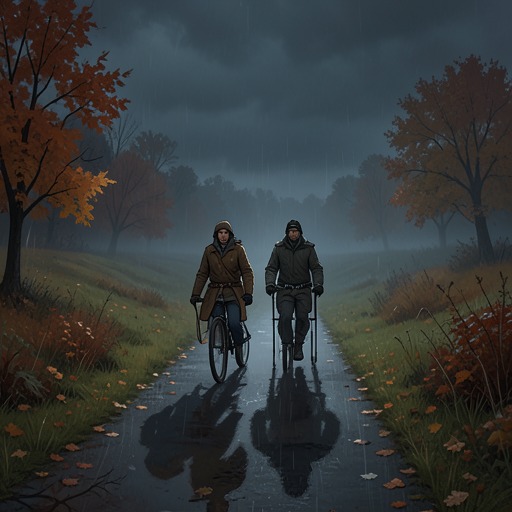
The path’s dependable routine eventually brought them toward Plymouth and the final stretch to Polruan. In steady rain, Ray saw the city as a threshold into an unknown future. Walking had offered the security of knowing what the next day required: pack the tent, shoulder the rucksacks, and continue. The prospect of stopping raised a deeper fear than financial difficulty or the practical work of starting again—the question of what would happen to Moth when they had to return to life beyond the path. Even ordinary route choices, including which ferry to pay for and where they might camp, carried the pressure of limited money and uncertain shelter. When plans faltered, panic surfaced rather than disappearing beneath the old routine. Resuming the South West Coast Path therefore does not solve the conditions that forced them to walk; it renews, for a time, the hard-won freedom of choosing the next step.